Markets.com Logo

ES

$--
--%
1d
1w
1m

Analysis and statistics

  • Open
    65.3721$
  • Previous Close
    65.7001$
  • 52 Week Change
    15.51$
  • Day Range
    -0.33$
  • 52 Week High/Low
    51.6387$ - 67.15$
  • Dividend Per Share
    0.0447
  • Market cap
    24 386 M$
  • EPS
    0.96
  • Beta
    0.619
  • Volume
    --

About

ES.US refers to the E-mini S&P 500 futures contract traded on the Chicago Mercantile Exchange (CME). It's a financially-settled derivative product that represents a fraction of the value of the Standard & Poor's 500 stock market index. Investors and traders use ES futures to speculate on the direction of the S&P 500, hedge existing equity portfolio risk, or arbitrage price discrepancies between the futures contract and the underlying index.

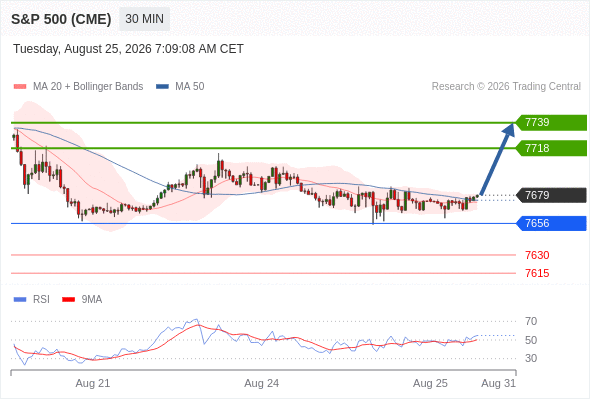
S&P 500 (CME) (M6) Intraday: the bias remains bullish.

Long positions above 6550 with targets at 6690 & 6720 in extension.

2026 Apr 02 23:33
S&P 500 (CME)
  • Our preference: long positions above 6550 with targets at 6690 & 6720 in extension.
  • Alternative scenario: below 6550 look for further downside with 6490 & 6450 as targets.
  • Comment: the immediate trend remains up and the momentum is strong.

Supports and resistances:

  • 6760 - Resistance *
  • 6720 - Resistance **
  • 6690 - Resistance ***
  • 6623 Last - Last
  • 6550 - Support ***
  • 6490 - Support **
  • 6450 - Support *

Factors

Economic Indicators: Strong economic data, like GDP growth and employment figures, generally boosts investor confidence and pushes prices higher. Conversely, weak data can lead to sell-offs.

Interest Rates: Higher interest rates can make borrowing more expensive, potentially slowing economic growth and negatively impacting stock prices. Lower rates can stimulate growth and investment.

Inflation: High inflation erodes purchasing power and can lead to businesses raising prices, which can hurt consumer spending and corporate profits. This can negatively affect stock prices.

Company Earnings: Strong earnings reports and positive outlooks from companies typically lead to higher stock prices, while poor performance and negative forecasts can cause prices to fall.

Geopolitical Events: Global events such as political instability, trade wars, or international conflicts can create uncertainty in the market, leading to volatility in stock prices.

Market Sentiment: Overall investor mood and expectations play a significant role. Positive sentiment can drive prices up, while negative sentiment can lead to declines.

Supply and Demand: Basic economic principles apply. If there is high demand and limited supply of a stock, the price will tend to increase. If there is low demand and high supply, the price will likely decrease.

People Also Watch

Latest news

US Steel and Aluminum Tariffs Revamped: Simplification Amidst Potential Cost Increases

Noah Lee|--

SpaceX Files Secret IPO Bid, Eyeing Record-Breaking $1.75 Trillion Valuation

Ava Grace|--

US Intelligence: Iran Unwilling to Engage in Substantive Talks to End War

Sophia Claire|--

Latest Education Articles

What Is Sensex in Stock Market: Meaning, Calculation, and Why It Matters for Investors

What Is Sensex in Stock Market: Meaning, Calculation, and Why It Matters for Investors

Ghko B|--
Investing basics for beginners: What are the 4 economic indicators?

Investing basics for beginners: What are the 4 economic indicators?

Frances Wang|--
CFDs vs Options: What’s the Difference?

CFDs vs Options: What’s the Difference?

Julian Parker|--