Markets.com Logo

AUD

$--
--%
1d
1w
1m

Analysis and statistics

  • Open
    246.5681$
  • Previous Close
    246.5681$
  • 52 Week Change
    102.80$
  • Day Range
    0.00$
  • 52 Week High/Low
    204.75$ - 307.55$
  • Dividend Per Share
    --
  • Market cap
    52 727 M$
  • EPS
    1.21
  • Beta
    1.468
  • Volume
    --

About

The financial product symbol AUD.F typically refers to the Australian Dollar futures contract traded on the Chicago Mercantile Exchange (CME). These futures contracts represent an agreement to buy or sell a specific amount of Australian Dollars at a predetermined price on a future date. Investors and traders use AUD.F futures to speculate on the future value of the Australian Dollar against the US Dollar, hedge against currency risk, and manage their exposure to fluctuations in the Australian Dollar exchange rate. The price of the AUD.F contract is quoted in US Dollars per Australian Dollar.

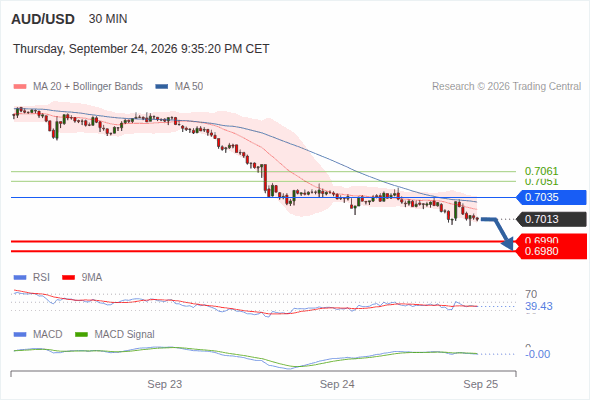
AUD/USD intraday : rebound towards 0.6928

The configuration is mixed.

2026 Apr 04 05:03
AUD/USD
  • Our preference: rebound towards 0.6928
  • Alternative scenario: below 0.6876, expect 0.6859 and 0.6849.
  • Comment: the RSI is below its neutrality area at 50. The MACD is above its signal line and negative. The configuration is mixed. Moreover, the price stands below its 20 and 50 period moving average (respectively at 0.6896 and 0.6904).

Supports and resistances:

  • 0.6939 * - Resistance *
  • 0.6928 ** - Resistance **
  • 0.6918 - Resistance ***
  • 0.6895 last - Last
  • 0.6876 ** - Support ***
  • 0.6859 * - Support **
  • 0.6849 ** - Support *

Factors

Interest Rate Differentials: Higher Australian interest rates relative to other countries can attract foreign investment, increasing demand for the Australian dollar and raising its value.

Commodity Prices: Australia is a major exporter of commodities like iron ore and coal. Rising commodity prices boost Australia's export income, strengthening the AUD.

Global Economic Growth: Strong global growth increases demand for Australian exports, supporting the AUD. Conversely, a global slowdown can weaken the AUD.

Risk Sentiment: The AUD is often considered a risk-on currency. During periods of global economic uncertainty, investors may flock to safe-haven currencies, weakening the AUD.

Australian Economic Data: Strong economic data releases, such as GDP growth, employment figures, and inflation data, can boost investor confidence and increase demand for the AUD.

RBA Policy: The Reserve Bank of Australia's (RBA) monetary policy decisions, such as interest rate adjustments and quantitative easing, can significantly impact the AUD.

Geopolitical Events: Global political events and tensions can influence investor sentiment and impact the AUD, often leading to increased volatility.

Market Speculation: Speculative trading activity in the foreign exchange market can also influence the price of the AUD, particularly in the short term.

People Also Watch

Latest news

US Steel and Aluminum Tariffs Revamped: Simplification Amidst Potential Cost Increases

Noah Lee|--

SpaceX Files Secret IPO Bid, Eyeing Record-Breaking $1.75 Trillion Valuation

Ava Grace|--

US Intelligence: Iran Unwilling to Engage in Substantive Talks to End War

Sophia Claire|--

Latest Education Articles

What Is Sensex in Stock Market: Meaning, Calculation, and Why It Matters for Investors

What Is Sensex in Stock Market: Meaning, Calculation, and Why It Matters for Investors

Ghko B|--
Investing basics for beginners: What are the 4 economic indicators?

Investing basics for beginners: What are the 4 economic indicators?

Frances Wang|--
CFDs vs Options: What’s the Difference?

CFDs vs Options: What’s the Difference?

Julian Parker|--